
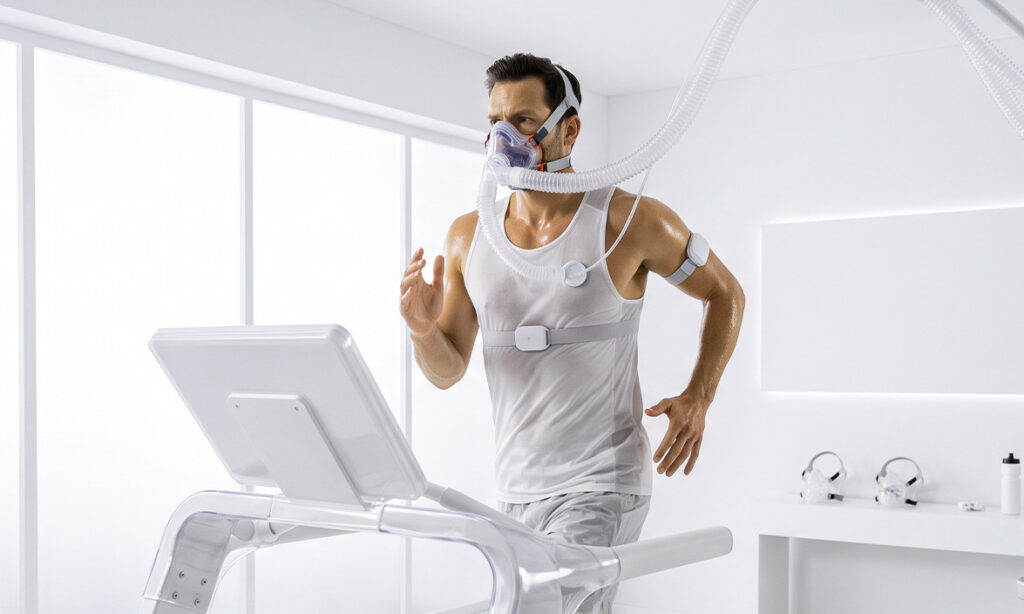
Cardiologists and longevity researchers rarely agree on much. They agree on this: VO₂ Max is one of the strongest predictors of longevity available, outperforming cholesterol levels, blood pressure, and even smoking status in some large-scale studies. And most people have never had theirs measured.
Here’s why that number deserves more attention than the one on your bathroom scale.
What VO₂ Max Actually Measures
VO₂ Max is the maximum rate at which your body can consume and use oxygen during intense exercise, measured in milliliters of oxygen per kilogram of body weight per minute. It’s a direct measure of how efficiently your heart, lungs, and muscles work together under maximum demand – pumping blood, extracting oxygen, and delivering it to working tissue.
A higher VO₂ Max means your cardiovascular system can deliver more oxygen to your muscles when you need it most, whether that’s sprinting for a train, climbing stairs without gasping, or recovering quickly between sets in the gym. It’s a direct window into how well your engine actually runs, not just how it looks on paper.
Why VO₂ Max Predicts Longevity So Strongly
The connection isn’t mysterious once you understand what VO₂ Max actually reflects: cardiac output, lung function, mitochondrial density, and how efficiently your muscles extract and use oxygen from blood. Every one of those systems is also implicated in age-related disease – cardiovascular disease, metabolic dysfunction, even certain cancers show correlation with cardiorespiratory fitness levels.
Large population studies have found that people in the lowest VO₂ Max quartile face dramatically higher all-cause mortality risk compared to those in the highest quartile – differences on the scale of years of life expectancy. It’s not a proxy for fitness vanity. It’s a proxy for how resilient your core biological systems actually are.
How VO₂ Max Is Measured
The gold-standard method involves a graded exercise test – typically on a treadmill or bike – while wearing a mask that measures the oxygen you inhale and the carbon dioxide you exhale. Intensity increases in stages until you reach maximum effort, and the equipment calculates exactly how much oxygen your body is consuming at that peak.
This is meaningfully different from the VO₂ Max estimates your smartwatch generates, which use heart rate patterns and algorithms to guess at a number rather than measure it directly. Wearable estimates can be useful for tracking trends over time, but they’re not a substitute for a direct clinical test when you actually want to know where you stand.
What a Good VO₂ Max Score Looks Like
VO₂ Max benchmarks vary significantly by age and sex, and comparing your number to a generic chart without that context isn’t useful. What matters more than a single snapshot is your percentile relative to your age and sex cohort, and your trend over time as you train.
Elite endurance athletes post numbers well above 60 ml/kg/min. Most sedentary adults fall well below 35. The gap between those numbers isn’t fixed – VO₂ Max is one of the more trainable metrics in the body, responding meaningfully to structured cardiovascular training within a matter of months.
How to Improve VO₂ Max
Zone 2 training – sustained, moderate-intensity cardio where you can still hold a conversation – builds the aerobic base and mitochondrial density that underlies VO₂ Max improvement. High-intensity interval training adds a second lever, pushing your cardiovascular ceiling higher through repeated near-maximal efforts. Most effective programs combine both, rather than relying on either exclusively.
Strength training plays a supporting role too – more muscle mass means more tissue capable of extracting and using oxygen, which indirectly supports VO₂ Max over time.
Frequently Asked Questions
How often should I get my VO₂ Max tested? Every 3-6 months is reasonable for someone actively training to improve it, giving enough time for meaningful physiological adaptation between tests without over-testing.
Can VO₂ Max improve at any age? Yes. Studies consistently show meaningful VO₂ Max improvements in adults well into their 60s and 70s with structured training, though the rate of improvement and ceiling may differ from younger adults.
Is VO₂ Max testing only for athletes? No — this is one of the biggest misconceptions. VO₂ Max is arguably more relevant for general health and longevity planning than for elite performance, since it’s directly tied to all-cause mortality risk regardless of athletic ambition.
Want to know your actual number, not a wearable’s estimate? Book VO₂ Max testing at Atlas BioFitness and get a clinical baseline to train against.