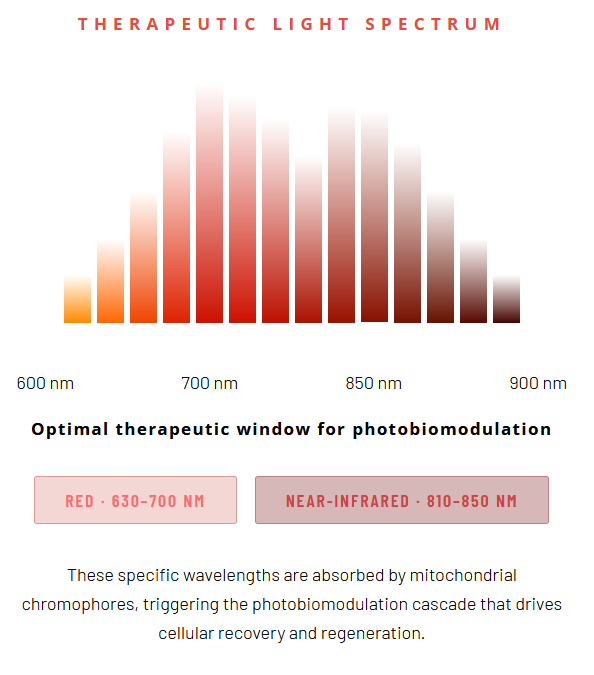
Red light therapy (RLT) — also known as photobiomodulation — uses specific wavelengths of red (630–700 nm) and near-infrared (810–850 nm) light to penetrate skin and tissue, directly stimulating mitochondrial function at the cellular level.
At Atlas BioFitness, our longevity-focused services combine red light therapy, personalized training and exercise, strategic nutrition support, medically directed weight loss, and hyperbaric oxygen therapy to enhance cellular health, metabolic function, strength, and recovery.
Integrated into personalized wellness, recovery, and longevity-focused programs at Atlas BioFitness, red light therapy is delivered through targeted protocols designed to help your body recover more efficiently, perform at a higher level, and maintain long-term cellular health — supporting vitality and performance for years to come.
Cellular Energy Production
Light photons are absorbed by cytochrome c oxidase in the mitochondria, boosting ATP synthesis — your body’s primary energy currency — for enhanced function across all tissues.
Inflammation Reduction
RLT modulates inflammatory pathways, reducing chronic and acute inflammation without systemic side effects — critical for recovery, joint health, and long-term metabolic wellness.
Muscle Performance
Pre-workout RLT sessions enhance muscle performance, endurance, and strength output. Post-workout use accelerates repair of micro-tears, reducing soreness and downtime between training.
Tissue Repair & Recovery
Stimulates the body’s natural healing cascade — fibroblast activation, collagen synthesis, and stem cell proliferation — to repair damaged tissue and accelerate recovery from injury.
Skin Health & Collagen
Drives collagen and elastin production for improved skin tone, texture, and elasticity. Shown to reduce fine lines, acne, redness, and scarring through consistent protocol application.
Circulation & Blood Flow
RLT promotes vasodilation and nitric oxide release, improving circulation to muscles and organs. Better blood flow means faster nutrient delivery, more efficient waste removal, and superior recovery.
Yes. Red light therapy is a completely non-invasive, non-thermal treatment with an excellent safety profile. It emits no UV radiation and does not damage tissue. It has been studied in thousands of peer-reviewed clinical trials and is used in medical, athletic, and wellness settings worldwide.
Many clients notice improved recovery and reduced soreness within the first few sessions. Structural changes — collagen remodeling, sustained inflammation reduction, muscle performance gains — typically emerge after 4–8 weeks of consistent protocol adherence. Longevity benefits accumulate over months and years.
Arrive with clean, dry skin — free of heavy lotions, sunscreen, or topical products that could absorb or reflect light. Wear minimal clothing appropriate to the area being treated. Hydrate well before and after your session to support cellular response and detoxification.
RLT is not recommended for individuals with photosensitivity conditions, those taking photosensitizing medications, or over active areas of suspected cancer without physician clearance. Pregnant women should consult their OB before beginning. Your Atlas specialist will review your health history at intake.
Most sessions run 10–20 minutes depending on the targeted area and your specific protocol. The session itself is effortless — you simply stand or lie near the panel while the light works. Plan for approximately 30 minutes total including check-in and any post-session notes with your specialist.
Most Atlas protocols prescribe 3–5 sessions per week for optimal results. Frequency is adjusted based on your goals — acute injury recovery may require daily sessions initially, while performance and longevity protocols typically follow a structured weekly cadence aligned with your training schedule.
Absolutely — and it’s most powerful in combination. At Atlas, RLT is integrated with personalized training, nutrition, medically directed weight loss, and hyperbaric oxygen therapy. Together, these services amplify each other for superior cellular health, metabolic function, and recovery outcomes.
Missy joined OMC in 2013. She graduated from Seattle Pacific University’s dietetic program and completed her dietetic internship through the University of Delaware. She worked for a year and a half with high-risk WIC clients before transitioning to the Olympia Multi-specialty Clinic. These varied experiences give Melissa a holistic perspective of her patients’ nutrition needs. Her focus is to promote good health via a whole food diet and regular exercise.
Dr. Linton joined OMC in 2014. He is board certified in Neurology, Clinical Neurophysiology and Sleep Medicine. He graduated from Tufts University School of Medicine and completed his residency and Fellowship in Neurology and Clinical Neurophysiology at Virginia Commonwealth University Medical Center. He also completed his Fellowship in Sleep Medicine at the University of Iowa Hospitals and Clinics. Dr. Linton provides comprehensive consultation, evaluation and treatment services for a wide range of both sleep-related and neurological disorders.
Dr. Berger joined Olympia Multi-specialty Clinic as a general Cardiologist in 2016. Dr. Berger graduated from Des Moines University College of Osteopathic Medicine. He then went on to complete his Internal Medicine Residency and Cardiology Fellowship at McLaren Hospital System, Macomb Campus. Dr. Berger has worked extensively as a volunteer participating in global health service missions in Belize and Guatemala. Dr. Berger embarks on his career by providing comprehensive consultation, evaluation and treatment services for a wide range cardiovascular diseases. Dr. Berger is board certified in Internal Medicine and Nuclear Cardiology.
Dr. Berger is excited to begin treating patients in Olympia and he knows the Pacific Northwest well. Continuing in his father’s footsteps, Dr. Berger is eager to share his expertise and provide cardiovascular care for the community he was raised in.
Dr. Chan joined OMC in 2015. He graduated from the University of California, San Diego School of Medicine. He then went on to complete his residency in Internal Medicine at Rush-Presbyterian St. Luke’s Medical Center in Chicago, IL, and completed his fellowship in Cardiology at Dartmouth-Hitchcock Medical Center.
Dr. Chan previously practiced Cardiology in Centralia, WA and Arizona before relocating back to the northwest. Dr. Chan provides comprehensive consultation, evaluation and treatment services for a wide range cardiovascular diseases. He is board certified in Internal Medicine, General Cardiology, Echocardiography, and Nuclear Cardiology. He is also a recipient of the American Heart Association’s Heroes Award, 2015.
Dr. Dunn joined OMC in 2013. He graduated from Loma Linda University School of Medicine and, completed his Internal Medicine Residency and Cardiovascular Disease Fellowship at the Loma Linda University Medical Center. Dr. Dunn then went on to complete his Interventional Cardiovascular Disease Fellowship at The Ohio State University Wexner Medical Center. He treats a wide range cardiovascular diseases and is credentialed to employ all modern interventional techniques. He also performs peripheral and coronary interventions. Dr. Dunn is board certified in Internal Medicine and Cardiovascular Disease.
Dr. Heap joined OMC in 2005 and is a native Washingtonian. He received his BA from Washington University, in Saint Louis, in Biochemistry and Molecular Biology. He received his MD from Saint Louis University School of Medicine. He completed his Internship, Residency, and Fellowship at the University of Illinois Medical Center. He is Board Certified in Internal Medicine and Gastroenterology/Hepatology. In addition to diagnostic and therapeutic endoscopy he also practices advanced endoscopy, including endoscopic ultrasound and capsule endoscopy.
Dr. Kuczynski joined OMC in August of 2011. He graduated from Southern Illinois University School of Medicine and subsequently completed his residency in Internal Medicine and his fellowship in Gastroenterology at the University of Arizona. He is board certified in Internal Medicine and Gastroenterology/Hepatology. Dr. Kuczynski treats a wide range of gastrointestinal diseases, while also performing diagnostic and screening endoscopies, capsule endoscopy and ERCP.
Philip Strunk is a native of Houston, TX. Philip earned his Bachelor of Business Administration and Masters in Professional Accounting from the University of Texas at Austin’s McCombs School of Business. He earned his designation as Certified Public Accountant (CPA) in 2004 and CERTIFIED FINANCIAL PLANNER (TM) certification in 2010. Having started his career with Deloitte & Touche, LLP in 2005, Philip spent a year and a half in Deloitte’s Audit and Assurance Services group and provided a variety of financial services for a number of Fortune 500 companies. He decided in late 2006 that his talent and passion for investments were best suited for working with smaller groups and individuals. After obtaining the required securities registrations and insurance licenses, Philip became a financial advisor. The impact was plainly visible and more fulfilling. Philip serves as the Investment Director for MPACT.