
Every med spa menu lists these three treatments like they’re interchangeable options for “younger-looking skin.” They’re not. They work through completely different mechanisms, target different concerns, and produce different results – and picking the wrong one for your actual goal wastes both your time and your money.
Here’s the honest breakdown.
Microneedling: Controlled Micro-Injury for Texture and Tone
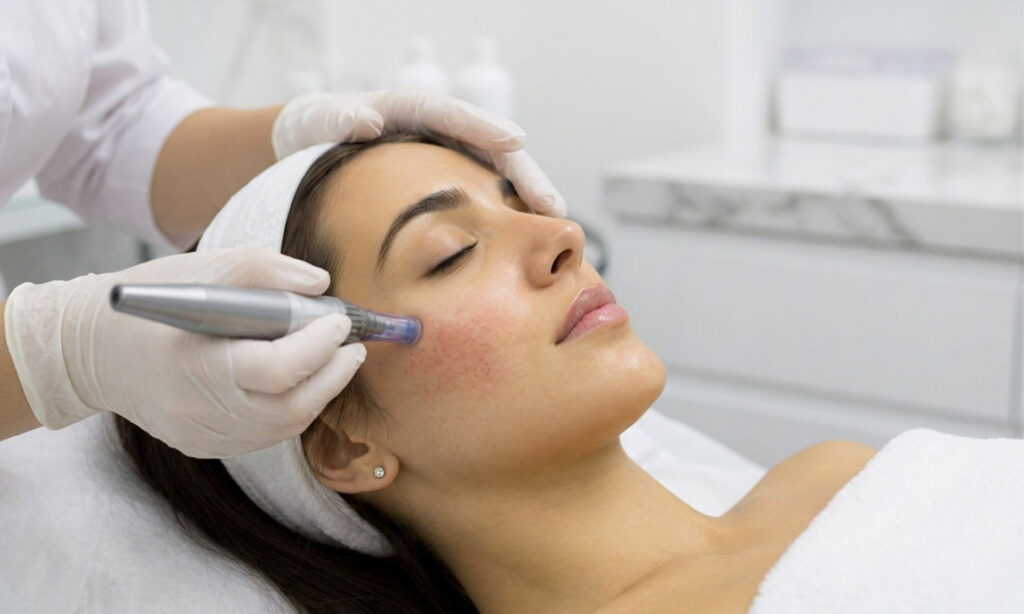
Microneedling uses fine needles to create thousands of controlled micro-injuries in the skin’s surface. Your body responds to that injury by ramping up collagen and elastin production as part of its natural repair process – the treatment essentially borrows your own healing response to rebuild the skin from within.
What it’s actually good for: improving texture, reducing the appearance of acne scarring, minimizing fine lines, and improving overall skin tone and firmness gradually over a series of sessions.
What it’s not built for: significant skin laxity or sagging. Microneedling improves texture and stimulates collagen, but it’s not a tightening treatment for meaningfully loose skin – that’s a different mechanism entirely.
Downtime: typically mild redness for a day or two, similar to a moderate sunburn.
Thermage: Radiofrequency Heat for Skin Tightening
Thermage uses radiofrequency energy to heat the deeper layers of skin – specifically targeting collagen in the dermis – causing existing collagen to contract immediately while stimulating new collagen production over the following months. That combination is what makes it a tightening treatment specifically, rather than a texture treatment.
What it’s actually good for: mild to moderate skin laxity, particularly around the jawline, neck, and areas where skin has started to lose firmness without requiring a surgical intervention.
What it’s not built for: significant, advanced skin laxity that a non-surgical treatment realistically can’t address – an honest consultation should tell you if your goals exceed what Thermage can deliver, rather than overpromising a surgical-level result.
Downtime: minimal – most people return to normal activities the same day, with results developing gradually over 2-6 months as new collagen builds.
Exosome Therapy: Cellular Signaling for Repair and Regeneration
Exosomes are tiny vesicles that cells use to communicate with each other, carrying growth factors and signaling molecules that direct tissue repair and regeneration. Applied topically or via microneedling, exosome therapy is designed to amplify the skin’s natural repair and regeneration signaling – essentially giving your skin cells more precise instructions for the repair process already happening.
What it’s actually good for: enhancing results from other treatments (frequently paired with microneedling to accelerate and improve collagen response), supporting overall skin regeneration, and addressing texture and tone alongside a primary treatment.
What it’s not built for: standing alone as a dramatic transformation treatment. Exosome therapy is most effective and most commonly used as an enhancement to another procedure, not a standalone dramatic intervention.
Downtime: minimal on its own; downtime typically reflects whatever primary treatment it’s paired with.
How to Actually Choose
If your primary concern is texture, scarring, or overall skin quality: microneedling, potentially enhanced with exosome therapy, addresses that directly.
If your primary concern is laxity or sagging, particularly around the jawline or neck, and you want to avoid surgery: Thermage targets that specific mechanism.
If you want to maximize results from a treatment you’re already considering: exosome therapy as an add-on amplifies the underlying repair process rather than replacing the primary treatment.
The honest answer for many people is a combination, sequenced correctly – not because more treatments is automatically better, but because texture and laxity are genuinely different problems requiring different mechanisms to address.
Frequently Asked Questions
Which treatment has the least downtime? Thermage typically has the least visible downtime, with most people resuming normal activities immediately. Microneedling involves mild redness for a day or two.
Can these treatments be combined? Yes, and they frequently are — microneedling paired with exosome therapy is a common combination, and Thermage can be used alongside either as part of a broader skin plan addressing both texture and laxity.
How soon will I see results? Thermage results develop gradually over 2-6 months as new collagen builds. Microneedling results typically become visible after a series of sessions, often 3-4 spaced several weeks apart. Neither is an instant-result treatment, because both work by stimulating a biological process, not masking the issue temporarily.
Not sure which treatment actually fits your skin goals? Book a consultation at Atlas BioFitness for a straight answer, not a sales pitch.