
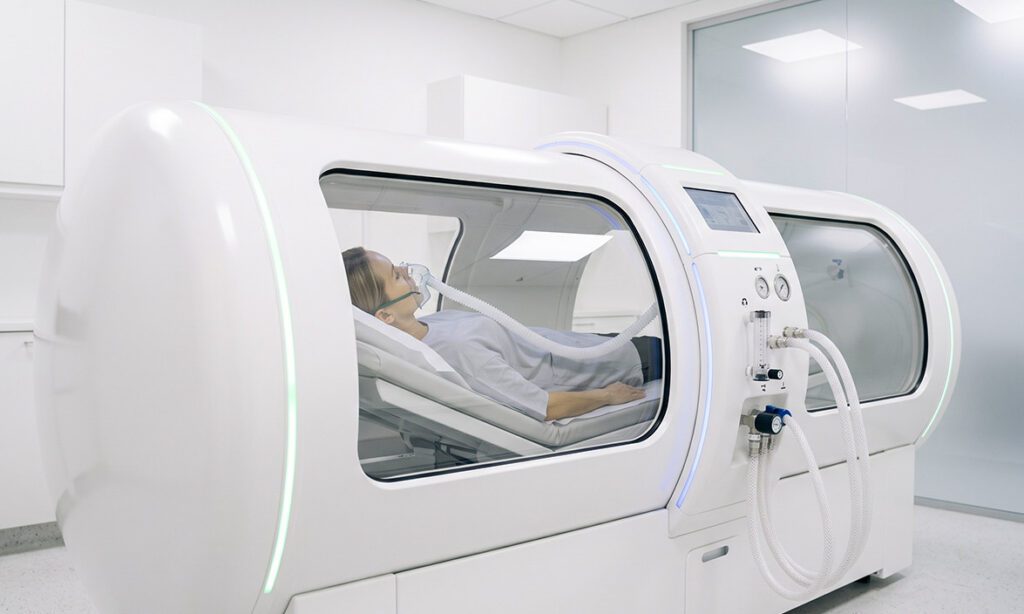
You’re not confused about hyperbaric oxygen therapy — you’re skeptical. And you should be. It’s been marketed as everything from an anti-aging miracle to a cure-all wellness trend, which is exactly the kind of noise that makes a legitimate therapy sound like a gimmick.
Here’s the plain version: hyperbaric oxygen therapy (HBOT) puts you inside a pressurized chamber and has you breathe concentrated oxygen. That pressure forces oxygen into your blood plasma at levels your lungs can’t achieve on their own – not just riding on red blood cells, but dissolved directly into your blood, plasma, and tissue fluid. More oxygen reaching stressed or damaged tissue means faster cellular repair, reduced inflammation, and improved circulation in areas your body has been struggling to heal.
That’s the mechanism. Now here’s what it means for you.
How HBOT Actually Works
Under normal atmospheric pressure, your red blood cells carry almost all the oxygen your body uses. They’re efficient, but they’re limited – there’s only so much oxygen a red blood cell can hold, and it can only go where blood vessels reach.
Inside a hyperbaric chamber, pressure increases to 1.5–3 times normal atmospheric levels. At that pressure, oxygen dissolves directly into your plasma — the liquid part of your blood — at concentrations up to 10 times higher than normal. That oxygen-rich plasma can reach tissue that damaged or narrowed blood vessels can’t fully supply. It also triggers the release of growth factors and stem cells that accelerate tissue repair, reduces swelling by constricting blood vessels while still increasing oxygen delivery, and fights certain types of bacteria that thrive in low-oxygen environments.
Who Benefits From Hyperbaric Oxygen Therapy
Clinical research supports HBOT for wound healing, particularly in cases where circulation is compromised – diabetic wounds, radiation injury, and certain infections. Athletes and active adults use it for soft tissue recovery after intense training or injury, when reducing inflammation and speeding tissue repair means getting back to movement sooner. It’s also used to support recovery after surgery and to address chronic fatigue tied to poor oxygen delivery.
The common thread: HBOT helps when the problem is oxygen delivery to tissue that needs it to repair.
What HBOT Won’t Do
It won’t reverse aging. It won’t replace strength training, sleep, or nutrition. It won’t fix a metabolic problem that has nothing to do with tissue oxygenation. If a treatment plan promises HBOT as a standalone solution to everything from joint pain to hormone imbalance, that’s marketing outpacing the science – and you should ask harder questions.
The honest use case is narrower and more useful: HBOT is a tool for accelerating recovery and healing in tissue that’s oxygen-starved. It works best as part of a coordinated plan, not a replacement for one.
What a Session Actually Looks Like
You’ll sit or lie in a pressurized chamber for roughly 60-90 minutes, breathing either ambient chamber air enriched with oxygen or oxygen through a mask, depending on the chamber type. Most people read, rest, or nap. The pressure change feels similar to a slight change in altitude – a mild ear-popping sensation as your body adjusts, nothing dramatic. Sessions are typically recommended in a series, not as a one-off, because tissue repair from increased oxygenation compounds over repeated exposures.
Is HBOT Right for You?
That depends on what you’re actually trying to solve. If you’re recovering from an injury, managing chronic inflammation, or working through slow-healing tissue, HBOT paired with a broader recovery and performance plan can meaningfully speed that process. If you’re looking for a shortcut around training, sleep, and nutrition, it isn’t that – nothing is.
At Atlas BioFitness, hyperbaric oxygen therapy is one part of a coordinated recovery approach that also includes compression therapy, infrared sauna, and physician-guided programming built around your actual biomarkers, not a generic protocol. The chamber doesn’t replace the plan. It supports it.
Frequently Asked Questions
Is hyperbaric oxygen therapy safe? For most healthy adults, yes. It’s a well-established medical therapy with decades of clinical use. As with any treatment involving pressure changes, certain conditions (like untreated pneumothorax or specific ear or sinus issues) require screening first – which is why HBOT should be administered under professional guidance, not a self-serve wellness trend.
How many sessions does it take to see results? It varies by what you’re treating. Wound healing and injury recovery often require a series of sessions over several weeks, since the benefit comes from repeated oxygen exposure supporting tissue repair over time, not a single visit.
Can I combine HBOT with other recovery therapies? Yes – and this is where it’s most effective. Paired with strength training, nutrition support, and other recovery modalities like compression therapy or red light therapy, HBOT becomes part of a system rather than an isolated treatment.
Ready to find out if hyperbaric oxygen therapy fits your recovery plan? Book a consultation with Atlas BioFitness and we’ll build a plan around what your body actually needs.