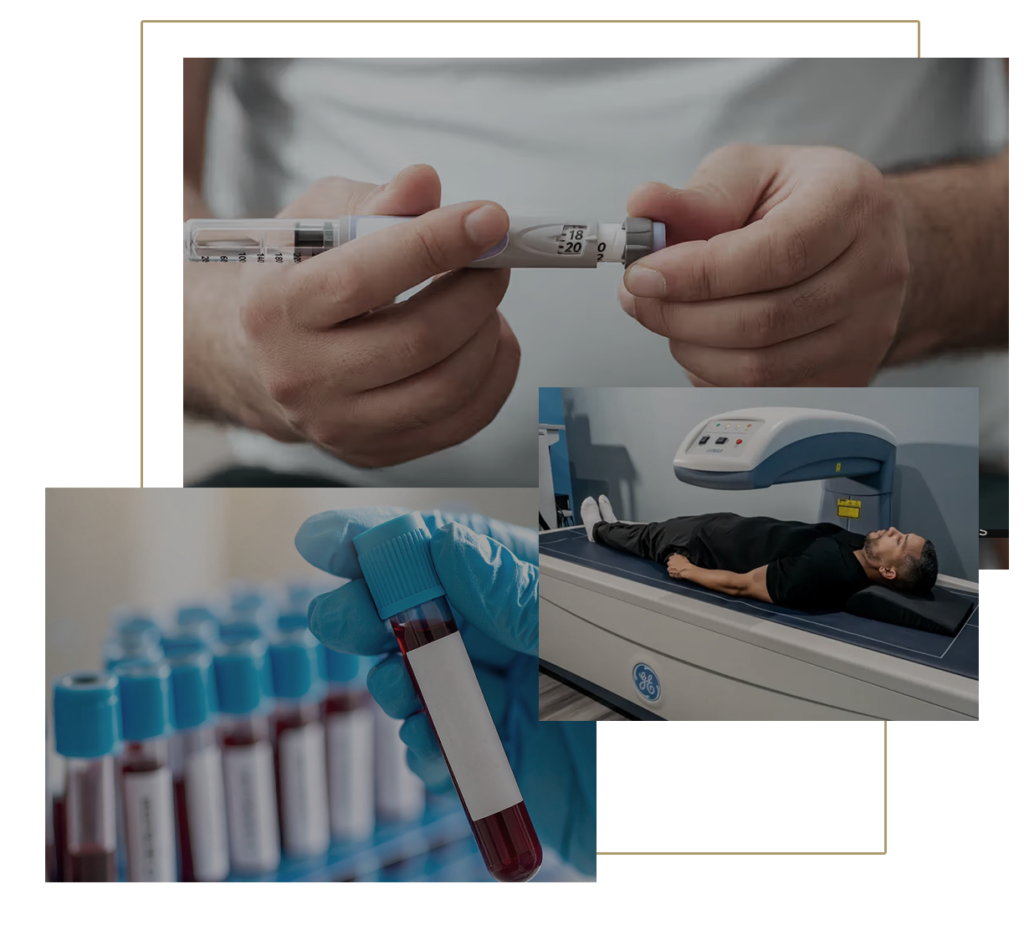
At Atlas BioFitness, our medically directed weight loss services combine physician-guided GLP-1 therapy, advanced lab work, bone density assessment, and DEXA-based body composition analysis to deliver a safe, personalized, and data-driven approach to sustainable fat loss and long-term metabolic health.
We go beyond fad diets and generic programs. Every protocol is built around your unique biology — tracked, adjusted, and refined over time by our clinical team.
Everything the Program Delivers
Our licensed physicians prescribe and monitor GLP-1 receptor agonist therapy, adjusting dosage based on your labs, body composition data, and clinical response for safe, effective results.
Advanced Lab Work
Comprehensive blood panels including fasting glucose, HbA1c, lipid profiles, thyroid function, and hormonal markers give us a complete metabolic picture before and throughout your program.
DEXA Body Composition
DEXA scanning provides sub-centimeter precision on fat mass, lean muscle, and visceral fat — the gold standard for tracking true body recomposition throughout your weight loss journey.
Bone Density Assessment
Many weight loss programs lead to bone loss. Our integrated DEXA bone density screening — including T-scores and Z-scores — ensures your skeleton stays strong as your body composition improves.
Ongoing Progress Monitoring
Regular check-ins, repeat labs, and DEXA follow-ups create a longitudinal record of your transformation. Your Atlas team adjusts your protocol in real time based on hard data — not guesswork.
Personalized Care Plan
No two metabolisms are the same. Your physician-designed plan incorporates nutrition guidance, activity recommendations, and medication management tailored specifically to your biology and goals.
GLP-1 therapy is typically appropriate for adults with a BMI 30 or above to aid with weight loss, adults with a BMI above 27 who have prediabetes or diabetes, sleep apnea, cardiovascular disease, or fatty liver. During your initial consultation, our physician will review your medical history, current medications, and lab values to determine whether GLP-1 therapy is safe and appropriate for you.
GLP-1 (glucagon-like peptide-1) receptor agonists are a class of medications that mimic a hormone naturally produced in the gut. They work by slowing gastric emptying, reducing appetite, and improving blood sugar regulation. When combined with lifestyle modifications, they have been shown in clinical trials to produce significant and sustained fat loss while preserving lean muscle mass.
These vary from patient to patient and will be discussed with you when you meet the physician and review you current health status.
The scale alone can be misleading — it cannot distinguish between fat loss and muscle loss. DEXA scanning measures fat mass, lean muscle, and bone density independently with clinical-grade precision. This means your physician can verify you are losing fat (not muscle), identify dangerous visceral fat reduction, and adjust your protocol if your body composition is trending in an undesirable direction.
Rapid weight loss — particularly with GLP-1 medications — can accelerate bone loss in some individuals, increasing the risk of fractures and osteoporosis over time. By including DEXA-based bone mineral density assessment with T-score and Z-score reporting, we proactively monitor your skeletal health and can recommend targeted interventions such as resistance training adjustments or nutritional support to protect your bones throughout the program.
The duration varies based on your individual goals, starting point, and health status. Most clients begin seeing meaningful body composition changes within 8–12 weeks. Sustained fat loss and metabolic health improvements typically develop over 6–18 months. Our program is designed for long-term success, not quick fixes, so your physician will recommend a timeline that reflects realistic, healthy progress for your body.
Our standard metabolic panel includes fasting glucose, HbA1c (three-month blood sugar average), complete lipid profile (HDL, LDL, triglycerides), thyroid function (TSH, free T3/T4), CMP (comprehensive metabolic panel), CBC, and key hormonal markers relevant to weight regulation. Additional specialized testing may be recommended based on your history and physician assessment. Follow-up labs are repeated at regular intervals to track your metabolic response and ensure medication safety.
Missy joined OMC in 2013. She graduated from Seattle Pacific University’s dietetic program and completed her dietetic internship through the University of Delaware. She worked for a year and a half with high-risk WIC clients before transitioning to the Olympia Multi-specialty Clinic. These varied experiences give Melissa a holistic perspective of her patients’ nutrition needs. Her focus is to promote good health via a whole food diet and regular exercise.
Dr. Linton joined OMC in 2014. He is board certified in Neurology, Clinical Neurophysiology and Sleep Medicine. He graduated from Tufts University School of Medicine and completed his residency and Fellowship in Neurology and Clinical Neurophysiology at Virginia Commonwealth University Medical Center. He also completed his Fellowship in Sleep Medicine at the University of Iowa Hospitals and Clinics. Dr. Linton provides comprehensive consultation, evaluation and treatment services for a wide range of both sleep-related and neurological disorders.
Dr. Berger joined Olympia Multi-specialty Clinic as a general Cardiologist in 2016. Dr. Berger graduated from Des Moines University College of Osteopathic Medicine. He then went on to complete his Internal Medicine Residency and Cardiology Fellowship at McLaren Hospital System, Macomb Campus. Dr. Berger has worked extensively as a volunteer participating in global health service missions in Belize and Guatemala. Dr. Berger embarks on his career by providing comprehensive consultation, evaluation and treatment services for a wide range cardiovascular diseases. Dr. Berger is board certified in Internal Medicine and Nuclear Cardiology.
Dr. Berger is excited to begin treating patients in Olympia and he knows the Pacific Northwest well. Continuing in his father’s footsteps, Dr. Berger is eager to share his expertise and provide cardiovascular care for the community he was raised in.
Dr. Chan joined OMC in 2015. He graduated from the University of California, San Diego School of Medicine. He then went on to complete his residency in Internal Medicine at Rush-Presbyterian St. Luke’s Medical Center in Chicago, IL, and completed his fellowship in Cardiology at Dartmouth-Hitchcock Medical Center.
Dr. Chan previously practiced Cardiology in Centralia, WA and Arizona before relocating back to the northwest. Dr. Chan provides comprehensive consultation, evaluation and treatment services for a wide range cardiovascular diseases. He is board certified in Internal Medicine, General Cardiology, Echocardiography, and Nuclear Cardiology. He is also a recipient of the American Heart Association’s Heroes Award, 2015.
Dr. Dunn joined OMC in 2013. He graduated from Loma Linda University School of Medicine and, completed his Internal Medicine Residency and Cardiovascular Disease Fellowship at the Loma Linda University Medical Center. Dr. Dunn then went on to complete his Interventional Cardiovascular Disease Fellowship at The Ohio State University Wexner Medical Center. He treats a wide range cardiovascular diseases and is credentialed to employ all modern interventional techniques. He also performs peripheral and coronary interventions. Dr. Dunn is board certified in Internal Medicine and Cardiovascular Disease.
Dr. Heap joined OMC in 2005 and is a native Washingtonian. He received his BA from Washington University, in Saint Louis, in Biochemistry and Molecular Biology. He received his MD from Saint Louis University School of Medicine. He completed his Internship, Residency, and Fellowship at the University of Illinois Medical Center. He is Board Certified in Internal Medicine and Gastroenterology/Hepatology. In addition to diagnostic and therapeutic endoscopy he also practices advanced endoscopy, including endoscopic ultrasound and capsule endoscopy.
Dr. Kuczynski joined OMC in August of 2011. He graduated from Southern Illinois University School of Medicine and subsequently completed his residency in Internal Medicine and his fellowship in Gastroenterology at the University of Arizona. He is board certified in Internal Medicine and Gastroenterology/Hepatology. Dr. Kuczynski treats a wide range of gastrointestinal diseases, while also performing diagnostic and screening endoscopies, capsule endoscopy and ERCP.
Philip Strunk is a native of Houston, TX. Philip earned his Bachelor of Business Administration and Masters in Professional Accounting from the University of Texas at Austin’s McCombs School of Business. He earned his designation as Certified Public Accountant (CPA) in 2004 and CERTIFIED FINANCIAL PLANNER (TM) certification in 2010. Having started his career with Deloitte & Touche, LLP in 2005, Philip spent a year and a half in Deloitte’s Audit and Assurance Services group and provided a variety of financial services for a number of Fortune 500 companies. He decided in late 2006 that his talent and passion for investments were best suited for working with smaller groups and individuals. After obtaining the required securities registrations and insurance licenses, Philip became a financial advisor. The impact was plainly visible and more fulfilling. Philip serves as the Investment Director for MPACT.